
ABOUT THE PRODUCT
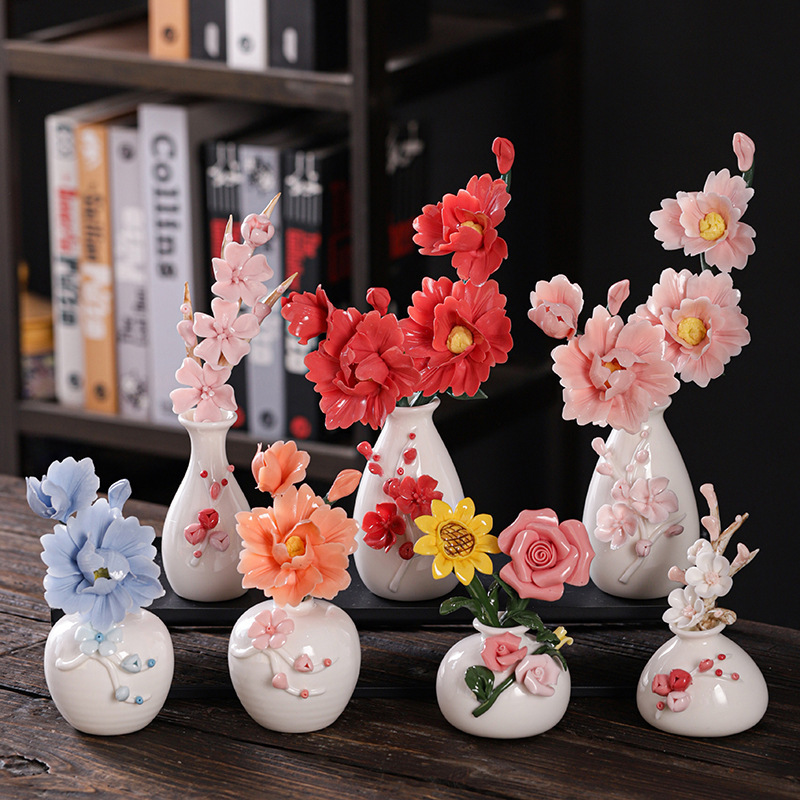
Chinese porcelain, one of the most representative artistic creations of Chinese civilization, embodies millennia of wisdom and aesthetic spirit. From ancient times to the present, porcelain has not only been an everyday object but also a carrier of the spirit of the times and the history of cultural exchange.
Porcelain originated from the development of pottery. As early as the Shang and Zhou dynasties, proto-porcelain appeared in China, with a hard body and glazed surface, representing the embryonic form of porcelain. During the Eastern Han dynasty, true porcelain was successfully fired in the Zhejiang region, marking China's entry into the porcelain age. During the Wei, Jin, and Northern and Southern Dynasties, celadon technology matured rapidly, with the Yue kiln producing celadon with its lustrous glaze, which was highly sought after.
During the Sui and Tang dynasties, the porcelain industry flourished unprecedentedly, forming a pattern of "green in the south and white in the north": the south was famous for Yue kiln celadon, while the north had Xing kiln white porcelain, as white as jade. Tang dynasty porcelain was also exported overseas along the Silk Road, becoming an important commodity in Sino-foreign trade. The Song Dynasty is hailed as the pinnacle of Chinese porcelain art. The "Five Great Kilns"—Ru, Guan, Ge, Jun, and Ding—each possessed distinct characteristics, pursuing a subtle, elegant, and naturally beautiful aesthetic, reflecting the refined tastes of the Song people.
During the Yuan Dynasty, Jingdezhen rose rapidly, and blue-and-white porcelain reached its mature stage. Renowned for its white ground with blue flowers and vivid decorations, blue-and-white porcelain became a classic in the history of world porcelain. During the Ming and Qing Dynasties, Jingdezhen was known as the "Porcelain Capital," with a well-established official kiln system and extremely high-level firing techniques. A multitude of varieties emerged, including doucai, wucai, famille rose, and enamel, with exquisite shapes and magnificent decorations. These porcelains were used in the imperial court and exported to Europe, profoundly influencing the development of world ceramics.
In modern times, Chinese porcelain has continuously innovated while inheriting traditional techniques. Jingdezhen, Dehua, and Liling remain important production areas, with art porcelain, daily-use porcelain, and high-tech ceramics developing together. Many artisans have integrated modern design concepts into traditional techniques, giving ancient porcelain a new lease on life.
From ancient kilns to modern workshops, Chinese porcelain has endured for millennia. It is not only an artistic crystallization of clay and fire, but also an important symbol of Chinese culture's global reach.
As modern porcelain artists, we are guided by the principle of inheriting and promoting the wisdom and skills of our ancestors, aiming to serve every ceramic enthusiast in the world. We use inheritance and innovation as our means to allow this craft to shine even more brilliantly in the new era!